Table of Contents


Growth stage diligence processes for most companies typically just have 3 facets
- Detailed understanding of historical numbers
- Narrative on how the company has got to where it is
- A 2-4-year projection to understand where it could potentially be, guided by the narrative on how to get there (new products, markets, or sales processes)
Since the universe of potential investments is discovered and mature, growth investors will typically keep engaging with companies across several quarters if not years to gain a conviction. It is a long process so we do try our best to prioritise and not boil the ocean each time.
Together, these conversations help provide conviction on the intentionality of your company’s performance. We index heavily on the consistency of your narrative, the processes you put in place because of it, and the metrics you chose to measure.
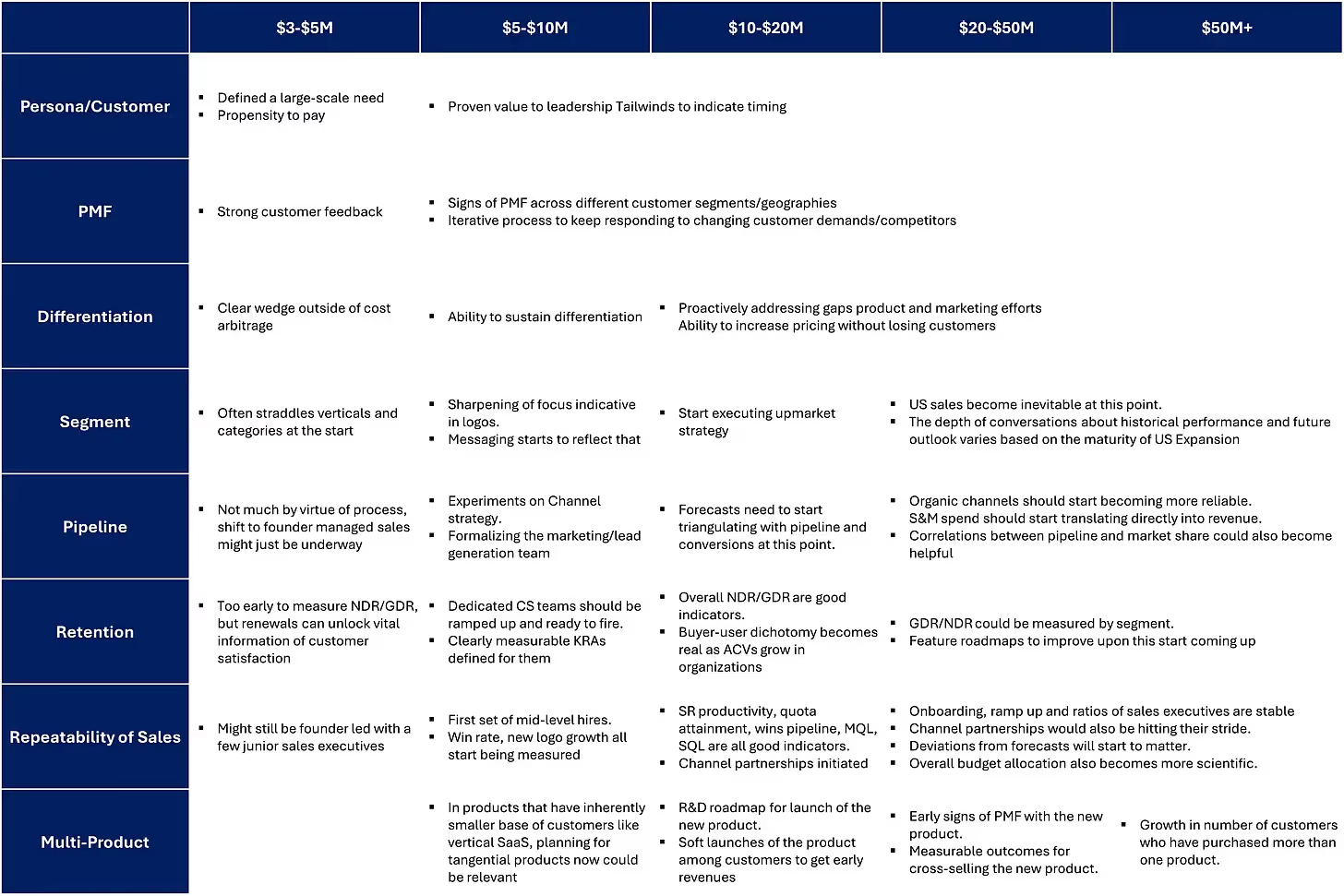
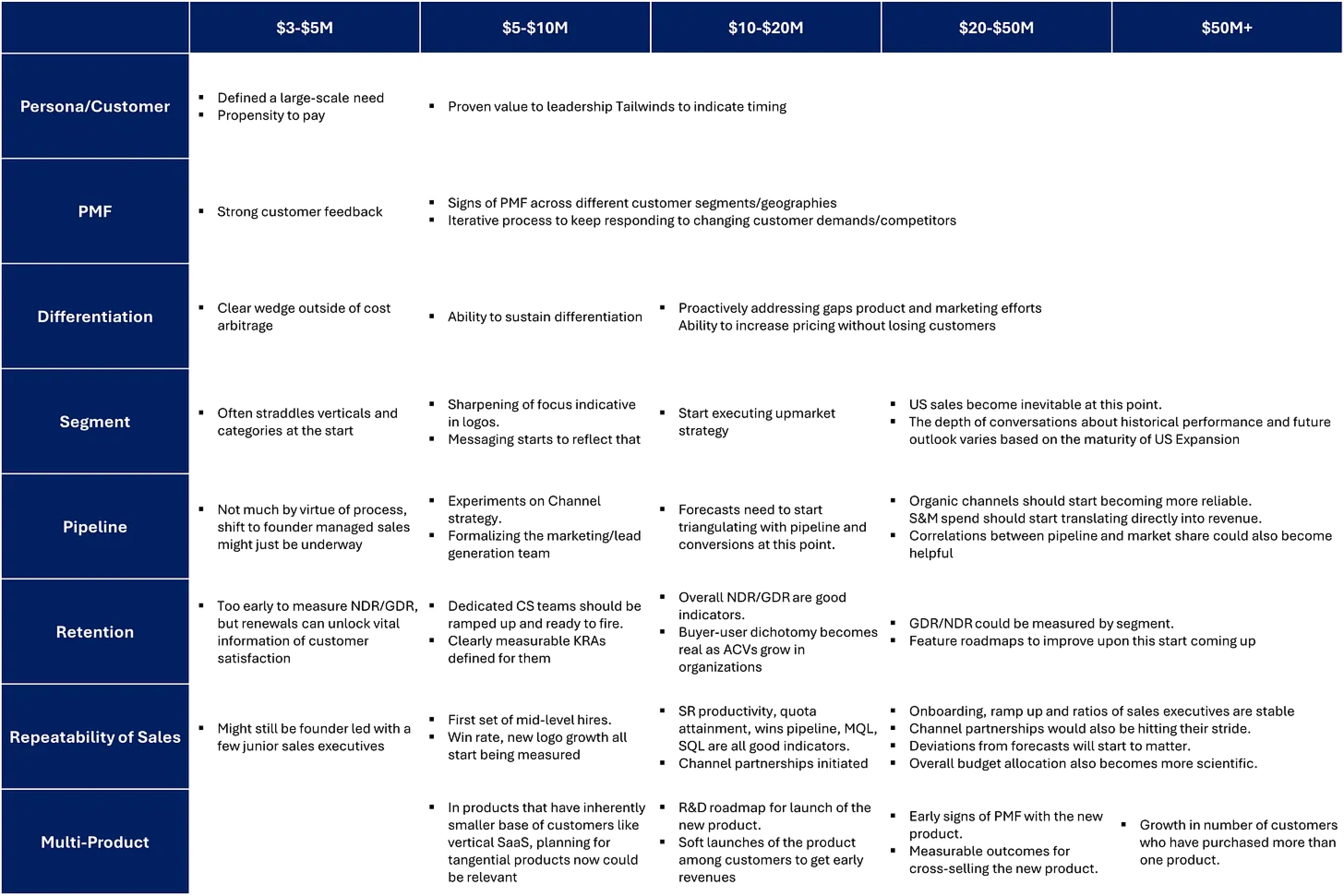
While there can be no specific benchmarks that can be applicable to the entire universe of SaaS companies, through our experience of interacting with numerous founders, operators, and co-investors we have arrived at a set of 8 core levers that will be relevant to think about once the company hits ~$3-4M ARR. Since some of them might be nascent when you’re early in the lifecycle, here is our estimate of when they can be true indicators.
I. Persona/Customer
Problems don’t exist in isolation. To truly understand how your company is addressing a challenge, we must understand the customer experiencing it. We want to understand who they are and what makes them tick.
Even as early as when you get to $100K ARR, there is some apparent value that is driving that monetization. So, we want to start with that.
Studying your customer persona deeply also allows us to arrive at your TAM which is as important as how relevant the pain point is. This becomes pertinent in category-creating plays. It would also be helpful to learn what tailwinds you are seeing and the implications it has.
For instance, Rocketlane, a category creator in customer onboarding, saw a wedge that was slowly unfolding. The tailwinds, in this case, are seeing customer onboarding evolve into a distinct function in a larger fraction of companies and the willingness of SaaS buyers to pay for implementation services. This shows that Customer onboarding is no longer a cost center but a source of revenue and points to signs of a growing market.
II. Product Market Fit
Assessing product market fit is the most opaque part of diligence processes. After extensive conversations with founders, we have realized that there are very few actual metrics that can attest to it. For investors, the necessary condition that assesses PMF is historic revenue growth. A sufficient condition however is more qualitative. It often requires detailed customer conversations centered around the problem and value realized through the product
Another way to asses this is whether all your customers are seeing similar value from the get-go or whether you still find yourself spending more money towards maintenance R&D to build incremental features for every customer
III. Differentiation from your customers
The ecosystem of enterprise software products has been in existence for over 30 years. There are very few blue ocean categories at play and investors are aware of that. Unlike the zero-sum nature of consumer platforms, enterprise software operates differently.
So what matters is your differentiation and your timing in the market
More than differentiation in absolute terms, tell us what it means for your customers. And what makes that differentiation persist only for you? It need not just be about the product but even a previously ignored market that finds the current offerings unsatisfactory.
Case in point Timo Rein’s anecdote on Pipedrive
I think it’s important to ask yourself whether you see your space crowded by things that you specifically do. In other words, the space might feel crowded for some, especially on a high level, but near empty for someone else. Depends on what you believe you’re solving.
In our case, CRM market was crowded for years before we came around, and it’s even more crowded now. People in San Francisco in 2011 asked us point blank, “Why would you enter the market that’s so crowded and dominated by Salesforce?”. For us, though, there were huge gaps in geographies, salespeople really didn’t think they had a tool built for them, acquisition models were too expensive for all parties, configurations were time-consuming, costly or even impossible, etc.
Here’s another one on Procore, whose resolution time was under 60 seconds which indicated their strong emphasis on customer support, a key differentiator
Our customer support team provides live support to all users on our platform at no additional cost, as well as numerous online resources, because we believe that if all users of our platform are successful, then our customers will be successful. We also believe time-to-resolution is critical, which is why in 2019 our average support response time to a user support request via online chat or phone was under 60 seconds, and we had positive customer support satisfaction rating of over 90%
As your scale grows, we will start probing on point of view on why your peers have been doing well and how you are addressing that through your messaging, product, and sales action plans
IV. Segment
Between Enterprise, Mid-market and SMB categories, what matters most is what that implies for your sales process. That said, very few categories lend to revenues from SMBs that can create centaurs.
Most companies at $3-$5M ARR don’t have a clear demarcation of where their past revenue came from, but it is reasonable to expect where you think the next $10M ARR of your revenue comes from. Upmarket motions are long-drawn out processes and will require compelling narratives on how you will make it happen. It is often a safer bet for a growth investor to wait to see how it will play out than to come into your company immediately.
Here's Dustin Moskovitz of Asana’s comments on how they were able to build a cross-functional set of capabilities to be able to move up the value chain for larger deal sizes.
The most common way we enter is through a marketing team, and then they're just immediately working with product and sales and legal on cross-functional workflows. I think it's accelerated over time, as we've built out more capabilities that service that exact need and have established ourselves as differentiated in being able to support cross-teamwork.
We're also just seeing more awareness of work management. As we move to larger deals, the topic is moving up higher in the org chart and the strategic chain. We're talking to more CIOs and C-level executives, who naturally have a cross-functional mindset as to how they're going to deploy it.
V. Pipeline
As the oxygen of your whole sales process, doubling down into pipeline strategies forms a cornerstone of conviction building. It is also a great metric to triangulate how realistic your forecasts can be.
At the $5-$10M ARR stage, it would be good to know about your experiments, learnings, and hiring for it. Beyond that point, pipeline generation should start to be a well-oiled machine.
As you reach a higher revenue scale, it would be good to think of your pipeline in terms of the market share which is the sure shot way to think of your TAM and your revenue scale in a 4-5 year horizon on an absolute basis
VI. Retention
While it might be nascent to fixate on the number itself, when your company has not yet hit $5M ARR, conversations around renewals, upselling or expansion are all still relevant. Companies also think of customer success as an afterthought and sometimes end up leaving money on the table by not investing in this early enough.
It is at this point that other users of the tool also come into picture as mentioned by Shensi Dingo of Merge
And it’s been interesting to discover that we get that initial buy from product and engineering teams but the renewals definitely have a heavy hand from the CS team. And it’s not the usual user vs buyer distinction as they’re both very much using us, just across different times.
The retention metrics (GRR & NRR) become extremely important for companies over $10M ARR given the rising contribution of revenue from existing customers with scale. We think both metrics are important because they do speak to different underlying phenomenon - GRR to measure your churn while NRR to measure your upselling/cross-selling potential
VII. Repeatability of Sales
While PMF and customer acquisition have an obvious correlation across all sectors, it is in SaaS that it becomes fairly empirical.
The repeatability of the sale process is about unlocking a clear unit of growth. For instance, if you want to increase sales by 1.5x, what are the input parameters (leads, sales pre, SDRs) that would need to be tweaked? The more homogenous and consistent your input parameters are (like having a mature sales hire onboarding process, and a proven ramp-up in sales productivity) the more repeatable your sales process is becoming.
- Forecasting is less about the exact number that is arrived at and more about how it is arrived upon.
- What is the error rate and margin of deviation? Is it possible to clearly pinpoint why the target wasn’t met at the smallest unit of the sales team?
- Since conversations with growth investors are often staggered over a long period of time, demonstrating the ability to execute through with the quarterly/yearly target you mentioned in the previous meeting inspires great trust in your execution abilities.
- Sales productivity and efficiency: With increasing maturity comes standardization of processes like sales executive onboarding, ramp-up duration, or the revenue per sales employee. The trendline with these metrics could be interesting indicators even as early as $5-$10M ARR. Sales efficiency is also especially helpful given the importance it has on the overall profitability level of SaaS companies.
VIII. Multi-product
While there are a few exceptional companies that have built a single product and grown to over $100M ARR, the others have gone multi-product. Companies typically start their journey towards a second product at the time of growth stage maturity. For <$20M ARR businesses conversations on where the next product can come from will begin.
Sometimes it could just be a significant feature that is being added to your platform like most companies today that have responded to AI. But it is important to keep in mind how revenue accretive that will be as explained by Petter Gassner of Veeva
Your customers will want things that are fairly easy to build, and you’ll understand those problems well, because they are add-ons to what you are already selling. But his point was these rarely move the needle. You don’t want a new product to add 10%-20% in revenue … you want to build a new product that can do 100%+ of your existing product’s revenue. Otherwise, it is too distracting and won’t ultimately move the needle.
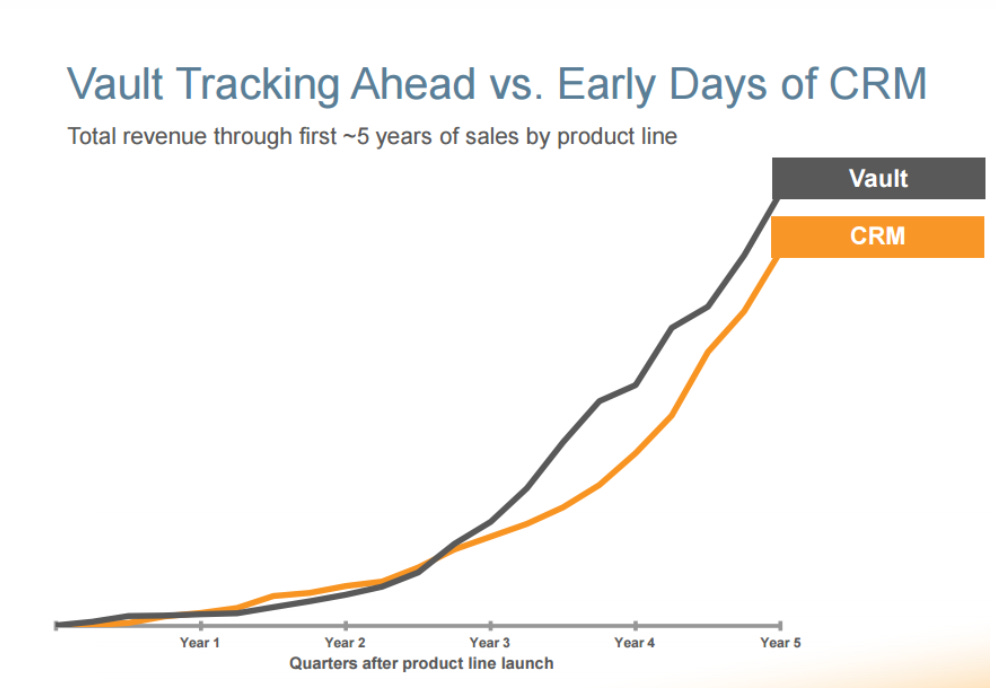
Once you are hitting revenues north of $20M ARR, narratives on new products should be supplemented with some signs of early traction. Positioning them as the silver bullet that will unlock future growth without showing any prior indications makes it hard for growth investors to underwrite
It goes without saying that frameworks like these are a definitive work-in-progress, with every new company we meet, we challenge our assumptions and aren’t afraid to change them if necessary. So we welcome any suggestions on how to enhance it further, do write to us at swathi.dhamodaran@trifectacapita.in about that.